Saturday, March 31, 2007


Friday, March 30, 2007
13th OF MARCH MASSACRE
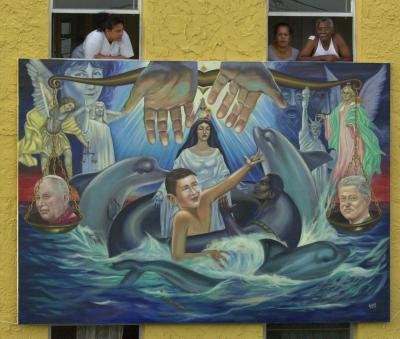
“13 de marzo” Tugboat Massacre, July 13,1994.
Thirty seven people drowned when the Cuban Coast Guard sank the hijacked tugboat “13 de marzo,” including eleven children:
Ángel René Abreu, age 3, Giselle Borjes, age 4, Juan Mario Gutiérrez, age 11, Caridad Leyva, age 4, Hellen Martínez, age 6 mos., Mayulis Méndez, age 17, José Carlos Nicle, age 3, Yousell Pérez, age 11, Yasser Perodín, age 11, Xicdy Rodríguez, age 2, Eliecer Suárez, age 11
Monday, March 26, 2007
WHAT EMBARGO?!
U.S. Remains Top Food Source for Cuba
Mar 25 02:40 PM US/EasternBy WILL WEISSERTAssociated Press Writer
HAVANA (AP) - Since 2003, one country has been the main supplier of food to Fidel Castro's Cuba: the United States.
Surprised? You have good company.
Many Americans think their government's 45-year-old embargo blocks all trade with the communist government, but the United States is the top supplier of food and agricultural products to Cuba. In fact, many Cubans depend on rations grown in Arkansas and North Dakota for their rice and beans.
Since December 1999, governors, senators and congressmen from at least 28 U.S. states have visited Cuba, most to talk trade. They keep coming: Nebraska Gov. Dave Heineman was flying in Sunday with a farm delegation. Gov. C.L. "Butch" Otter of Idaho plans a visit next month.
Washington's sanctions choke off most trade with Cuba, but a law passed by Congress in 2000 authorized cash-only purchases of U.S. food and agricultural products and was cheered by major U.S. farm firms like Archer Daniels Midland Co. interested in the untapped Cuban market.
Cuba refused to import one grain of rice for more than a year because of a dispute over financing, but finally agreed to take advantage of the law after Hurricane Michelle in November 2001 cut into its food stocks.
Since then, Cuba has paid more than $1.5 billion for American food and agricultural products, said John Kavulich, senior policy adviser at the U.S.-Cuba Trade and Economic Council of New York.
The $340 million in exports in 2006 represented a drop of about 3 percent from 2005, which was down from nearly $392 million in 2004. Kavulich said the decline was caused mostly by generous subsidies and credits from Venezuela and China.
But the U.S. remains on top. Its main exports to Cuba include chicken, wheat, corn, rice and soybeans—much of it doled out to Cubans on the government ration. The United States also sends Cuba brand-name cola, mayonnaise, hot sauce and candy bars, as well as dairy cows.
Kirby Jones, founder of the U.S.-Cuba Trade Association in Washington, said Cuba's food import company Alimport has an entire department dedicated to American purchases.
Jones was in Cuba this month with Arkansas chicken exporters, Nebraska bean growers and officials from the Port of Corpus Christi, Texas.
"Hundreds and hundreds of American executives have come down here," he said. "(Cuban officials) know how to talk to us."
An assistant to Pedro Alvarez, Alimport's chairman, said the company could not comment without authorization from Cuban press officials.
But Cuban parliament speaker Ricardo Alarcon has said Havana does not expect the U.S. embargo to be eased under President Bush. The current administration tightened restrictions in 2004, further limiting U.S. travel and imposing stricter rules for Cuban payments on U.S. goods.
Don Mason of the Iowa Corn Growers Association agreed, saying he was "less than optimistic" Washington will make it easier to trade with Cuba any time soon. He said the association ships on the order of 450,000 metric tons of corn to the island each year.
Any significant change in U.S. policy would be difficult under the 1996 Helms-Burton law, which prohibits normalization of relations with Cuba as long as 80-year-old Fidel Castro or his brother Raul are in charge. Fidel temporarily ceded power to Raul after emergency intestinal surgery in July.
Despite repeated moves in Congress to ease or eliminate the sanctions, the embargo still has supporters from both parties in both houses.
U.S. Rep. Jerry Moran, a Kansas Republican, introduced a bill in February seeking to promote American agricultural sales to the island by letting Cuba directly wire payments to U.S. banks rather than route them through third countries. But a similar measure introduced in 2005 was not approved.
Some believe American interest in Cuba's new oil exploration efforts could change the political tide.
The island plans deep-water drilling, searching for deposits of crude oil less than 100 miles from Florida's coast. Energy companies from China, India, Spain and elsewhere are interested in investing, but American firms are shut out.
U.S. senators Larry Craig, an Idaho Republican, and Byron Dorgan, a North Dakota Democrat, introduced a measure this month that would open Cuban waters to U.S. oil and natural gas companies.
"If that passes, the embargo goes out the window," Jones said. "We're not talking about mayonnaise now. We're talking about million and millions of dollars."
Sunday, March 25, 2007

FAMILIES DESTROYED BY FIDEL CASTRO
Benito Cortés Maldonado, Age 41.
Executed By Firing Squad on January 13, 1959, in Santiago de Cuba. U.S. citizen by birth. Born In Ponce, Puerto Rico.
Occupation: Policeman and pilot.
Place of residence: Reparto Aguero, Santiago de Cuba.
The Cortes family had gone to Cuba when Benito was a boy, to expand their businesses in Puerto Rico to Cuba. They were very successful. When Benito came of age, he loved the police force and decided to join. He married a Cuban woman and had five children.
When Batista fled and the revolutionaries came to power, on January 1, 1959, a fellow policeman had gone into hiding and asked him to join in. He had declined, saying he was well known and regarded, has always done his duty, never committed any crimes, and had nothing to fear. Raúl Castro, however, rounded up 165 men –police and military personnel under Batista- on January 12, 1959. After very brief summary trials, with total disregard for due process, had ordered them executed. They were taken at dawn to an old airfield and shot in front of ditches, their bodies buried there. A witness to the executions, who later defected from the government, told the Cortes family that Benito had survived the shooting and had fallen to the ground from a shot to the leg. A militiaman went over and shot him in the head.
The family did not recover his remains for burial. It is thought that he was buried in the ditch where he fell, with the rest of the firing squad victims.
Cuba Archive has testimony of a field with many ditches dug in sequence at San Juan Hill in Santiago de Cuba, to accomodate the serial executions taking place in the first months of the Castro regime.
Sources: Guillermo Cortes, son. Resident of Florida. Personal, written and telephone testimony, 2005 and 2006. Copies of birth and death certificates.
Notes from telephone conversations with son, Guillermo Cortes (resident of Florida), March 10 and 11, 2006. By María C. Werlau
Both Benito's mother and father were from Puerto Rico. The family was well off and his father wanted to extend his enterprises to Cuba. Benito left with his father for Cuba to establish businesses there. They did very well, owned three coffee plantations and even their own private plane.
Benito married a Cuban girl from a poor family. The family lived in Palma Soriano, Oriente province. Guillermo was the oldest of five children.
Benito was a pilot. Guillermo remembered how he would hear him circling the family home from above, he would know his father was coming to get him. His father was very dashing. He loved life in uniform and joined the police force, serving under Batista when he was in power, but he was a good a and respected man, who did harm to no one.
When Castro came to power, a friend in the police force urged Benito to leave the country with him. It would have been easy, as he was a pilot, but he said he had nothing to fear, as he had always done his duty and hurt no one or done anything wrong.
Benito was detained on January 11 or 12 and taken to Santiago, falsely accused of raping a woman. Raúl Castro decide to have scores of "batistianos" killed. They fabricated charges and executed him on January 13th, 1959 with 164 others.
They took them to an old airfield, dug trenches, stood them in front, and shot them. A witness, a man who participated but later turned against the government, told the family he had fallen down, shot in the leg. A lieutenant walked over and shot him on the head.
Guillermo was 14, an intern at the Escolapios de Guanabacoa school, when they notified of his father’s death. The family left Cuba in 1960 for New York.
Guillermo enlisted in the Army, served during the Cuban Missile Crisis, married, and is a Protestant Chaplain. He lived in Arecibo, Puerto Rico, for ten years, working for Abbot Laboratories. He adored his father and all his life he wanted to be like his father, becoming for example a pilot, like him (in Arecibo, Puerto Rico, when he lived there).
Guillermo is both Puerto Rican and Cuban. He married a woman from Puerto Rico and had her go to Puerto Rico to deliver their children so they would be born there. He cannot go to Cuba, is on a government black list. He often serves a Chaplain on cruise ships that circle Cuba. He stares at the island, with grief in his heart.
When he attended the Memorial Cubano 2004 in Miami (www.MemorialCubano.org) and saw the cross with his father's name, he broke down, sobbing. He had never had a chance to mourn his father at his tomb.
The long trail of blood begins in Oriente
January 12-13, 1959
The Revolution had triumphed barely 12 days earlier, after Batista left the country at dawn on New Years’ Day. It was the afternoon of January 12, 1959. On the west cost of the island, in Santiago, Raúl Castro irrupted in the room where over one hundred members Batista military, police, and civilian supporters were being judged by a Revolutionary Tribunal. A multitude of people filled the locale. Raúl –wearing the olive green uniform of the Rebel Army, a black cap on his head and a caliber 45 pistol under his belt- tightly held a machine gun with his left hand. Suddenly, he yelled irately, “Bring this comedy to an end. These despicable men don’t even deserve a trial, they are unworthy dogs.” With the crowd yelling insults at the prisoners, he ordered them into trucks in groups of 12 to 15 and had then taken to San Juan Hill. There, in the shooting range of Madrevieja, they were executed in groups. Many cried out “Long live Cuba,” or “Long live Christ the King” as the firing squad platoon did its deed. The killing went on all night, past dawn of the next day, January 13. The victims were buried in mass graves dug by bulldozers at San Juan Hill.
Source: Testimony attributed to a lawyer who witnessed the events. In Alberto Alonso, “El baño de sangre comenzó en Oriente,” Defensa Institucional Cubana, Enrique Pizzi de Porras, ed., Año XI, Nro. 124, México, D.F.
Published by
Cuba Archive
(www.CubaArchive.org)
an initiative of the
Free Society Project, Inc.
The Martin Family
The Martin Family
Armando Martín Vázquez, Age 34,
Mercedes Romero Vargas, Age 32,
and son Yuniel Martín Romero, Age 11.
Residents of Mariel, Pinar del Rio, Cuba.
Drowned August 7, 1994 in the Florida Straits attempting to flee Cuba for the United States.
The family left on a small boat from Mariel, Pinar del Rio Province, with another family of three, by the last name Busot. On another boat was a group of 5 or 6 relatives, also from Mariel.
On August 7, 1994, in the Florida Straits, a storm developed and their boat capsized and they plus the Busot couple drowned. Only the child of the Busot family was saved, as he was pulled to safety unto the other boat.
Sources: Testimony by Armando Martín's uncle, resident of Florida, March 2006.The survivors, who made it to Florida, told the story on local media, including Channel 23.


