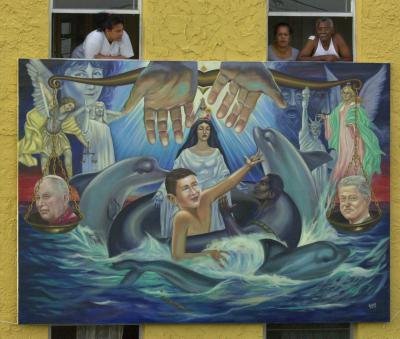
"Nobody is in agreement…It’s that, no one says it and no one takes the risk to say it, to speak the truth. That’s what is happening. In other words, one of the foundations, of what are the regimes in the entire world, in all of history, has been fear and lies. In other words, once you are in fear that's when you don’t take a risk, where you collect yourself and don’t unite…understood? To be in fear is not to offer help to anyone because that signifies risk." -Gorki Águila Carrasco, lead singer, guitarist of the music group Porno Para Ricardo and political prisoner
"Socialist ideology, like so many others, has two main dangers. One stems from confused and incomplete readings of foreign texts, and the other from the arrogance and hidden rage of those who, in order to climb up in the world, pretend to be frantic defenders of the helpless so as to have shoulders on which to stand." --Jose Marti

View Che Guevara's Forgotten Victims on Scribd

SEARCH? GOOGLE IT!

Google
Showing posts with label firing squad. Show all posts

Thursday, February 14, 2008

CROSSES THAT REMEMBER

Print This Article

Crosses honor anti-Castro dead

Forty-six years later, José Crúz says he still vividly remembers the dreaded sound of the firing squads that executed thousands of Fidel Castro opponents in the early years of the Cuban revolution.

'I can still hear the firing squad commanders yelling `ready, aim, fire!' and then, just before the volley, the defiant cries of the victims, 'Long live Christ the King!' and 'Long live free Cuba!,' '' said Crúz, 71, a former Cuban political prisoner.

He was among a dozen volunteers who on Thursday worked late into the night setting up neat rows of 10,000 white foam crosses -- a symbolic ''war cemetery'' in south Miami-Dade evoking the memory of people who have died at sea or been killed by firing squad as a result of actions blamed on the Cuban government.

The sixth annual Cuban Memorial ''honoring victims of the Castro regime'' will formally open Friday and be on display to the public until Sunday at Tamiami Park, 11201 SW 24th St.

Organizers plan a news conference and ceremony at noon Friday to dedicate the memorial. Visitors can walk among the crosses, each bearing a name, from noon to 9 p.m. Friday, 9 a.m. to 9 p.m. Saturday, and 9 a.m. to 5 p.m. Sunday.

No one knows for sure how many people have died as a result of the Cuban communist government's direct or indirect actions, but some exile activists include those who were executed, those who have died attempting to leave Cuba by crossing the Florida Straits or those who have been killed in action fighting the Cuban government or who died in prison.

The nonprofit group Cuba Archive, www.cubaarchive.org, has documented 9,074 cases of people who have died fighting against the regime or trying to escape the island since the Cuban revolution in 1959. Maria Werlau, the group's executive director, said many more people have died but their deaths have yet to be documented. New names are added to the database all the time, she said.

Other experts cite higher estimates but that's because they include more than 11,000 Cuban soldiers killed in foreign deployments ordered by Castro such as in Angola, and higher estimates of Cuban migrants drowned at sea.

The number of Castro foes executed by firing squads has been estimated at more than 4,000 by the Cuba Archive program.

Emilio Solernou, one of the Tamiami Park memorial organizers, said the crosses his group has put on display bear the names of verified deaths as a result of executions, or who have died in prison or attempting to cross the Florida Straits.

Crúz, a former anti-Castro militant in Havana in the 1960s, was locked up for 18 years as a political prisoner. He was 24. He remembers an intensification of executions at the infamous La Cabaña prison in Havana immediately after the failed 1961 Bay of Pigs invasion.

''One evening I heard eight executions and another evening nine,'' Crúz recalled as he set up crosses at Tamiami Park. ``It was horrible. I heard the discharge of several rifles and then the single coup de grace shot each time.''

Thursday, May 3, 2007

THREE MORE FOR THE FIRING SQUAD...


HAVANA (AP) - Fugitive army soldiers tried to hijack a plane bound for the United States on Thursday and killed a military officer they took hostage during the failed attempt, the Interior Ministry said.
The ministry blamed U.S. policies that the communist government says encourage Cubans to emigrate to the United States and also said it was a result of Washington's tolerance of violence against Cuba.
The incident began before dawn when the fugitives commandeered a regular city bus near the airport and forced it to drive inside and onto the tarmac of terminal 2, which services charter flights between the Cuban capital and the United States. The exact destination of the plane in the United States not known, but most charter flights out of Terminal 2 fly to Miami.
Army Lt. Col. Victor Ibo Acuna Velazquez was killed aboard the plane but there were no crew members or passengers on board at the time, the ministry statement said.
"Despite being unarmed, he heroically tried to prevent the commission of the terrorist act," the ministry statement said of officer killed.
The other passengers on the commandeered bus were unharmed and the two fugitive soldiers were arrested.
The incident comes amid an ongoing political campaign by Havana accusing the U.S. government of protecting its archenemy, Luis
Posada Carriles. Cuba alleges the 79-year-old Cuban militant of involvement in a deadly airline bombing three decades ago and a string of Havana hotel bombings in the late 1990s.
Hundreds of thousands of people marching in Havana on Tuesday to mark May Day protested against the recent release from U.S. custody of Posada Carriles.
"The responsibility for these new crimes lies with the highest-ranking authorities of the United States, adding to the long list of terrorist acts that Cuba has been the victim of for nearly half a century," the ministry statement on Thursday said.
Caridad Carbonel, who has lived in the shadow of Havana's airport for 34 years, said she was awakened by gunfire and saw a vehicle roll onto the tarmac through a side checkpoint.
"Last night, there was a terrible shootout," the 68-year-old said, adding that she saw ambulances swarm the area and had heard about the death of a
military officer several hours before Cuba's government confirmed it Thursday evening.
The two soldiers arrested were among three who escaped with automatic rifles from their military base on Sunday after killing a fellow soldier and wounding another. The statement said the third soldier who fled was captured earlier, but it did not say when.
There had been a massive manhunt under way for the three. The
Defense Ministry over the weekend distributed wanted circulars around Havana, describing the fugitive soldiers as armed and dangerous and saying they were sought for abandoning their posts. Some circulars were displayed in public places, including post offices.
The men, all from the
eastern province of Camaguey, were identified as Leandro Cerezo Sirut and Alain Forbus Lameru, both 19, and Yoan Torres Martinez, 21. It was not immediately clear which two were involved in the attempted hijacking.
Throughout the day Thursday, there were rampant rumors of a shooting at the airport but the
Cuban government and its official media were silent.
Several baggage handlers told an Associated Press reporter who visited the airport that police had told them to tell anyone who asked to say that nothing had happened there that morning. Even so, none of them had appeared to have heard or seen the pre-dawn incident.
Later Thursday, all was calm and there was no increased police presence at the airport's Terminal 2.
About 150 people who lined up outside the terminal for their outgoing flights, or waited for loved ones to arrive from the United States, seemed oblivious that anything may have occurred there earlier.
Two departures for Miami and one to New York later in the day were listed on time, as were the scheduled arrivals from those cities.